Dr Flávia Fayet-Moore
Dr Flávia Fayet-Moore, widely known as Dr Fláv, is an award-winning nutrition scientist, space nutritionist, international keynote speaker, and global thought leader. A self-described “foodie nerd”, she is Brazilian-born, Canadian-raised, and Australian-made, bringing a unique international perspective to human health.
She holds an Honours degree in Nutritional Sciences from the University of Toronto, alongside a Master of Nutrition and Dietetics and a PhD in Nutrition Science from The University of Sydney. Notably, she is the first dietitian in Australia to be board-certified in Lifestyle Medicine. Dr Fláv is an Adjunct Lecturer at the University of Newcastle and actively contributes to the editorial boards of journals like Public Health Nutrition.
As the CEO and founder of FOODiQ Global, she focuses on bridging science, industry, and public health impact. Her career has been dedicated to shifting the paradigm toward a food-first approach, actively tackling critical concerns such as micronutrient deficiencies, chronic disease prevention, and childhood health.
Her passion for scientific enquiry extends into extreme environments; she serves as a space nutritionist and was the principal investigator for Mission MushVroom. This globally recognised project sent the first crop of mushrooms into space on the SpaceX Dragon capsule to analyse future food systems and sustainability.
Connect & Global Insights
Join Mission Mushvroom!

Space Will Feed Our Future: Dr Flávia Fayet-Moore on Mission Mushroom
Award-winning nutrition scientist Dr Flávia Fayet-Moore breaks down the high-stakes world of space food and explains how her project, Mission Mushroom, is paving the way for sustainable food systems on Earth and beyond.
[00:00:13] Dr Flávia Fayet-Moore thrives at the intersection of food, nutrition science, and space exploration. She operates with a bold guiding philosophy: **space will feed our future**. By engineering solutions to feed just 10 humans on a deep space mission to Mars, we inherently develop the localised innovation and agricultural technology required to feed 10 billion people back on Earth.
The Evolution of Space Food
[00:04:34] Space food has come a long way since the early days of spaceflight. In 1961, Yuri Gagarin proved that humans could physically swallow and absorb nutrients in microgravity by eating beef liver pate, coffee, milk, and chocolate sauce out of tubes. Today, space nutrition focuses heavily on mental well-being, joy, and culture. Food acts as a primary source of psychological comfort and a rare form of autonomy for isolated astronauts.
[00:05:32] Modern crews on the International Space Station (ISS) choose from over 200 different meal options, receiving a fresh resupply of off-the-shelf items, dehydrated packets, and fresh fruit every two to three months. However, because launching cargo into space costs thousands of dollars per kilogram, long-duration missions to the Moon and Mars must rely on closed-loop, resource-restricted farming systems.
Why Mushrooms Are the Ultimate Space Crop
[00:09:38] As a nutrition scientist, Dr Flávia spent years researching mushrooms before realising that oyster mushrooms (Pleurotus ostreatus) are uniquely suited as a space crop. Sitting in their own biological kingdom separate from plants, fungi are more closely related to humans. This grants them remarkable structural and nutritional advantages:
- Vitamin D Generation
Just like human skin, mushrooms synthesise high amounts of vitamin D when exposed to UV light. Just three to four button mushrooms can deliver 100% of an astronaut’s daily requirement, targeting bone health and immunity to replace the only mandatory pill astronauts must take in space. - The Umami Effect
Mushrooms possess a rich, savoury “umami” flavour profile. This helps reduce the need for salt in an astronaut’s diet, which is critical because high sodium intake accelerates calcium leaching from human bones already vulnerable to microgravity bone loss. - Rapid Growth & Zero Waste
Fungi grow picking-ready and are 100% edible, eliminating structural crop waste like leaves or stems. Oyster mushrooms can double in size every day, utilising minimal water, zero fertiliser, and closed-loop carbon sources. In fact, NASA has demonstrated they can successfully grow on used T-shirts.
Mission Mushroom and the Fram2 Flight
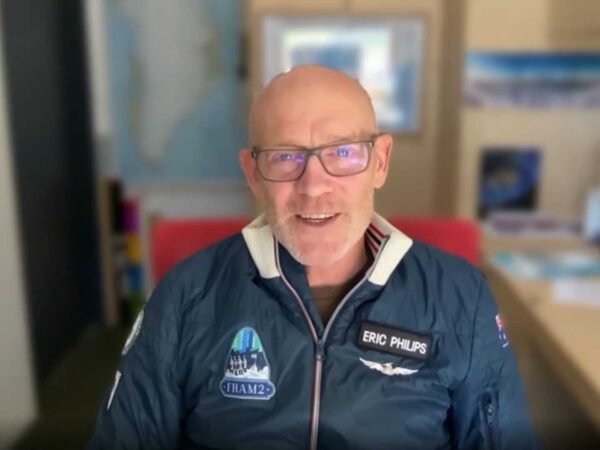
[00:14:07] To turn this concept into reality, Dr. Flávia served as the Principal Investigator (PI) for **Mission Mushroom**. The biological project secured a spot on the historic **Fram2 mission**—the first human spaceflight engineered to orbit Earth over the polar regions. Australian polar explorer and private astronaut **Eric Philips** was put in charge of the payload while in orbit.
[00:15:15] The experiment utilised a highly confined payload consisting of six blue Falcon centrifuge tubes containing a substrate colonised with mushroom mycelium on grain. To jumpstart the biological process, the lab team cut precise “X” shapes into a substrate block to introduce oxygen, sealed it inside a humidity-retaining bag, and handed it over to SpaceX for launch.
The Flight Findings: Growth in Extremes
[00:17:02] The findings from the three-and-a-half-day orbital flight were profoundly exciting. Even when subjected to intense rocket vibrations, cosmic radiation, and zero access to clear oxygen, the mycelium actively adapted. Microscopic analysis revealed that the space samples grew and successfully produced tiny baby mushrooms.
While the overall nutritional values remained structurally matching to Earth ground controls, the space-grown hyphae showed significantly higher rates of network fusion. It was as if the organism was working harder in microgravity to weave an interconnected mesh.
The Future of Fungal Agriculture
[00:18:21] Moving forward, Dr. Flávia highlights that space biology must establish rigid fungal safety standards. Future research must determine whether to deploy sporeless strains to protect spacecraft air systems, ensure zero unique toxins are generated in orbit, and explore how spent mycelium blocks can be repurposed into architectural structural concrete.
[00:19:38] Sharing a moving photo of her nine-year-old daughter, Talara, watching the rocket launch, Dr. Flávia closed with a message of unyielding determination: “Believe in your idea, start acting on it, and continue being curious and having awe about the world around you.”