Making the Artemis missions tangible for students
For many students, the connection between the space industry and their everyday lives can seem very far away. The Apollo missions were something that they’ve seen on TV or in a movie, the shuttle era was something that happened when their parents were young, and for some students, they haven’t even heard of the Artemis missions. And yet, the Artemis missions are a huge leap forward as we take humans back to the lunar surface!
The Artemis missions are our chance as educators to connect the work done in space with the world students’ experience. We can connect the research, the engineering, the human endeavour and ingenuity to the lunar missions that will unite the world when Artemis II travels around the Moon and when Artemis III lands on the lunar south pole.
So with this in mind, what can we as educators do to inspire our students?
From Classroom to Crater: Mapping the Lunar South Pole
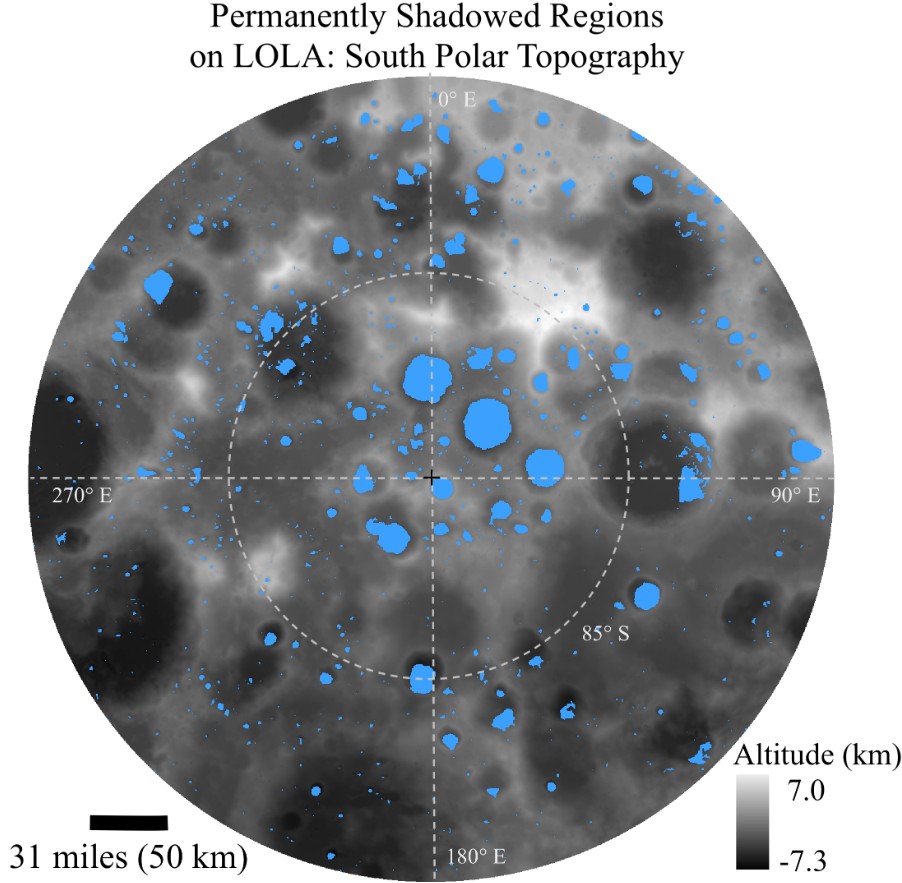
Permanently shadowed regions (in blue) on the Moon poleward of 80 degrees South latitude. Data from the Lunar Orbiter Laser Altimeter instrument on board NASA’s Lunar Reconnaissance Orbiter spacecraft. NASA/GSFC/Timothy P. McClanahan
Do your students know that there is water ice at the lunar south pole? Why would this even be important? There are 9 potential landing sites for the Artemis III mission could visit. Part of the many roles of the astronauts is to investigate the geology of the area and to bring back samples to Earth. These samples will provide a plethora of data, including how the lunar regolith formed and the potential for water ice to create rocket fuel in the future.
Is this an opportunity for your students to investigate how they would extract water ice efficiently from a rock aggregate sample that you create as a simulation for them? You could also create your own impact craters in this simple experiment, where students can think about craters from the point of view of a scientist wanting to investigate subsurface materials, ejecta material and permanent shadow areas
The Lunar Lunchbox: Sustaining Life in Deep Space
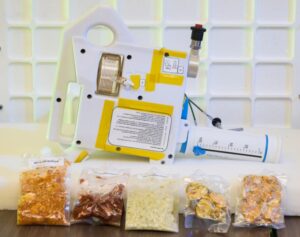
Mini Potable Water Dispenser prototype in development at NASA’s Marshall Space Flight Center, is displayed at NASA’s Johnson Space Center alongside various food pouches. NASA/David DeHoyos
Space is hard. Nutrition and access to water in space are longstanding issue that faces the space industry as we consider longer stays beyond the confines of Earth’s biosphere. The Artemis missions are forcing engineers & scientists to consider how sustainable nutrition and access to water be maintained for long stays on the lunar surface. We cannot just bring everything and keep getting resupply missions, at some point we need to be sustainable and grow our own food and harvest our own water.
This is a huge opportunity for your students to join the AVA Challenge in a design sprint to solve the simple question – What do We Eat? You can go further with this, as the AVA Challenge & Magntiude.io has partnered with the ARC Center for Excellence for Plants in Space for a plant growth experiment you can run with your students, as well as having partnered with Food IQ Global on Mission Mushvroom, a fungi experiment that recently flew on the FRAM 2 mission.



Engineering for the Moon: The Physics of the SLS and Orion

NASA Space Launch System and Orion Spacecraft Credit NASA & Joel Kowsky
The power of NASA’s Space Launch System (SLS) is extraordinary. Built by Boeing, the SLS is a super-heavy-lift rocket designed to carry astronauts and cargo to the moon in a single launch. This is a fantastic time for students to review the technical specifications of the SLS, and to think about the physics needed to escape Earth’s gravity as well as the guidance systems needed to ensure that the mission can reach and maintain a lunar orbit.
Do your students know that the Australian space industry has rocket launch facilities? Do your students know that they can join amateur rocket clubs and University student rocket teams? The path towards rocket science is not as obscure as it seems once they know there are real certifications they can earn and that Australia’s space sector is growing, with jobs available in this industry.
Why Go Back? Connecting Lunar Tech to Life on Earth
This is a perennial and fair question for students ask. Why spend so much money to take astronauts back to the lunar surface when there are so many issues to deal with back on Earth? Put simply, there is economic sense in investing in the engineering and sciences to pull off the Artemis program. Ask someone from the space industry about the benefits of space research and development for the public and they can name many:
Technology “Spinoffs”
Much of the technology developed to keep humans alive on the Moon ends up in our kitchens, hospitals, and pockets.
- Water Purification
Systems built for the ISS and Artemis can be used to provide clean water in remote villages and disaster zones globally. - Health & Medicine
Infrared ear thermometers, ventricular assist devices (heart pumps), and advanced medical imaging (MRI/CAT scans) all have roots in NASA technology. - Everyday Tech
CMOS image sensors (the “eyes” in your smartphone camera) and the precision of modern GPS were refined through space exploration needs. - Memory foam (originally for crash protection), freeze-dried food, and firefighting gear were all accelerated by space program requirements.
The Economic Impact
Investing in space isn’t “throwing money at the Moon”—it’s an investment in high-tech jobs and local industry here on the ground.
Global Level (2025–2026 Estimates)
The Global Space Economy
Valued at approximately $626 billion USD in 2025, it is projected to grow to over $1 trillion by the early 2030s.
World Economic Forum, 9 Dec 2025
NASA’s Multiplier Effect
Economic reports indicate that for every $1 NASA spends, it generates over $3 of economic output across the U.S. economy let alone worlwide
NASA’s Impact
NASA’s Economic Impact Study 2023
Australian Level (2025–2026 Estimates)
National Turnover: The Australian space sector currently has an annual turnover of approximately $4.6 billion to $5 billion AUD.
The industry employs around 17,000 people across 620+ businesses. The Australian Space Agency aims to grow this to 20,000 jobs by 2030. The Australian Government committed $150 million AUD (2021 to 2026) to help local companies join the Artemis supply chain. This includes the “Roo-ver”—a world-class Australian-built rover set to head to the Moon.
Australian Trade & Investment Commission, 12 December 2025
Meet Roo-ver, Australian Space Agency
Key Takeaway for Students
We don’t send “bags of money” into space.
Every cent is spent on Earth—paying the salaries of scientists, welders, programmers, and even the farmers who provide the food for the teams on the ground.
Training Like an Astronaut: The Human Element of Artemis

NASA astronaut Kjell Lindgren using the Advanced Resistive Exercise Device (ARED).
Consider the training that an astronaut has to go through to prepare for an Artemis mission. Everything is measured and for good reason. This is an opportunity for your students to consider how they might use accessible technology and other resources to create their own regimen for fitness. It doesn’t have to be as rigorous or as demanding as an astronaut or athlete, but the exercise of panning routines and managing energy intake and output alongside good nutritional health is beneficial regardless and also helps students understand the mindset of an astronaut as they prepare for a space mission.
It’s up to us
Educators have always been the bridge between cultural moments and students’ lives. Our role is to help students not only understand a given concept but also to help connect students to the greater meaning of what is happening here and now. The Artemis missions are here and now. The explorations and discoveries made in these missions will continue to make our lives better now and into the future. Lets conenct our students with this momentous occasion.
Artemis is their Apollo mission.
It’s going to be memorable!
Happy teaching,

Home » Articles »