Australian Virtual Astronaut Challenge
ExoLab-13: Mission MushVroom
Successfully clone Pleurotus ostreatus; Design a solution around carbon cycles.
The 4-phase challenge:
- Fruit and harvest a substrate block.
- Clone from mushroom tissue culture.
- Expand the spawn across grains.
- Create a bulk substrate.
Partners
- FoodIQ Global
- Magnitude.io
- Rootlab
- AVA Challenge
This optional investigation requires an official AVA mushroom substrate block.
Magnitude.io is donating the school license for free ($360 value) with the purchase of the official $40 substrate block from AVA Challenge partner, Rootlab. To qualify for the free license, use the order button below before 4 March 2026, with the coupon applying at the checkout.
Princess of Pearl Oyster | Pleurotus ostreatus | Mushroom Grow Kit- Spray and Grow – 3kg (click here)
Each participant will start from the same material at approximately the same time. Rootlab will hold all orders to be shipped on 5 March 2026 just prior to mission start to ensure your mushroom block is mission ready!



Steps
Control the variables, measure the results
Steps:
| Phase | Action | Goal |
| 1 | Fruiting & Harvest: Hydrate and monitor your official substrate block until maturity. | Track the lifecycle (pinning to full development) and select the healthiest fruitbody for cloning. |
| 2 | Tissue Culture: Extract inner tissue from the harvest and transfer cuttings to agar plates or liquid culture. | Achieve sterile transfer in a controlled environment to establish a clean culture on a solid or liquid medium. |
| 3 | Spawn Expansion: Transfer the colonised mycelium (from the agar or liquid culture) to sterilised grains. | Expand the mycelial mass onto a nutrient-dense carrier (grain spawn) to create a vigorous “seed.” |
| 4 | Bulk Inoculation: Mix the fully colonised grain spawn into a new bulk substrate. Your final substrate is an interesting exploration. Cereal straws, sawdust, coffee grounds, corn cobs, and even paper products like cardboard, newspaper, toilet paper rolls can be used. Maybe those unpaired cotton socks in your drawer have a new purpose! | Complete the biological loop, enabling students to fruit a second generation (clone) of the original mushroom. |
Resources to be published soon!
About Mission MushVroom
Mission MushVroom is a pioneering 2025 experiment led by Australia’s FOODiQ Global, took place on Fram2. Fram2 was the first human spaceflight to explore Earth from a polar orbit aboard the SpaceX Falcon 9 rocket. It tested the viability of growing oyster mushrooms in microgravity as a sustainable, nutrient-dense food source for long-term lunar and Martian missions. As an extension of this mission, it is now your goal to utilise mushrooms’ ability to convert waste into food.
Goal: To determine if oyster mushrooms can successfully fruit and colonise in microgravity as a sustainable, nutrient-rich, umami-flavored food source rich in vitamin D for deep space exploration.
The Experiment: Astronauts on the Fram2 mission monitored how oyster mushrooms grew in microgravity.
Significance: Oyster mushrooms rapidly grow in small spaces, doubling in size daily, and are packed with a rich nutrient profile. Oyster mushrooms are also highly resilient, scalable, and capable of growing using 100% of the inedible plant waste, and even cotton t-shirts in their growth medium!
Lead Researcher: The project was led by space nutritionist Dr. Flávia Fayet-Moore of FOODiQ Global.

Option:
ExoLab
The ExoLab system can be purchased but is not required!
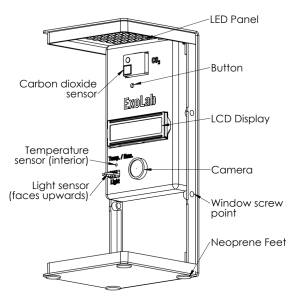
ExoLab is a network of science laboratories that connect Schools, Science Centers, Libraries, and Museums around the world. Just like payloads that goes to destinations like the International Space Station, your ExoLab is just 10cm x 10cm x 20cm. In our upcoming mission, lessons and mission progress are tracked in Magnitude’s easy to use Learning Management System over a 4-phase, 12-week program.
In your ExoLab, we track and measure different conditions, such as how hot or cold it is (temperature), how wet or dry it is (humidity), how much light there is (lux level), and how much carbon dioxide (CO2) is present. There is a camera in the lab that takes a picture every hour. The images from this camera and the data from these measurements are then shown together. You can compare the information from your lab to other labs all over the world.