Non-Earth Imaging: Using AI to See Space from Space
Dr. James Allworth from HEO discusses how Artificial Intelligence and Machine Learning are used to identify satellites, estimate their orientation, and manage the growing challenges of space traffic. While most satellites look down at our planet, HEO turns the cameras around to take high-resolution pictures of other spacecraft and space debris, using Artificial Intelligence to make sense of a crowded and fast-moving orbit.
[00:00:21] Most imaging satellites perform “Earth Observation.” HEO does the opposite: they use satellites to take pictures of other spacecraft. This allows them to get clear, resolved imagery that ground-based telescopes can’t capture due to atmospheric interference and weather.
How AI Detects Objects in Motion
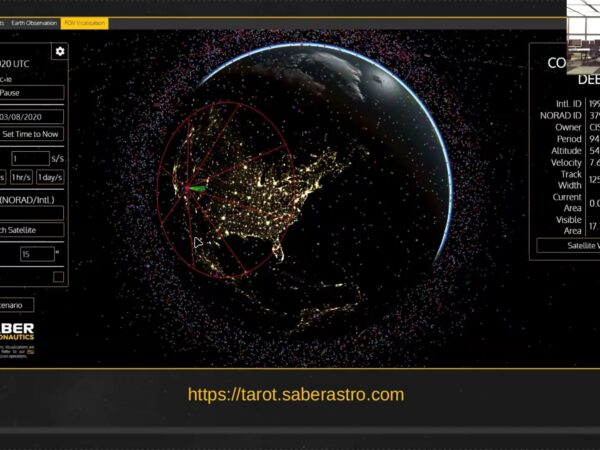
[00:01:54] Satellites in Low Earth Orbit (LEO) move at about 7.5 kilometers per second. When two satellites pass each other, the relative velocity can be as high as 12 kilometers per second. To put that in perspective, it would take only three seconds for a satellite to travel the 25km distance from Sydney’s CBD to Parramatta.
[00:04:32] To find a target in this high-speed environment, HEO takes thousands of images. AI models, specifically Deep Convolutional Neural Networks, scan these images to identify which few frames actually contain the target spacecraft. This replaces the need for human analysts to manually click through thousands of photos, a process Dr. Allworth describes as highly inefficient.
Three Ways HEO Uses Machine Learning
Dr. Allworth outlines three primary applications for AI in their current workflow:
- Object Detection: Identifying a spacecraft against a complex background, even in poor lighting conditions.
- Opportunity Selection: Using “Random Forest” algorithms to analyze thousands of potential flybys per day and select the one that will produce the highest-quality image.
- Attitude Determination: Using pattern-matching to determine which way a satellite is pointing or how a piece of space debris is tumbling.
The Future: Edge Computing in Space
[00:07:08] In the past, all images had to be “downlinked” to Earth before they could be analyzed, which is expensive and slow. The future of the industry lies in Edge Computing—deploying AI directly onto the satellite’s own computer in space. This allows the satellite to “think” for itself and only send back the successful images, significantly reducing costs and time.
Advice for Students: Space is Domestic
[00:12:08] Dr. Allworth, originally from Sydney, notes that the career landscape has changed. In the past, Australians often had to move to the US or Europe to work in space. Today, companies like HEO allow engineers and data scientists to work on real-world spacecraft right here in Australia. His advice? Study math and physics, and remember that AI is a precise tool—you must apply the right model to the right problem.
Home » Articles »