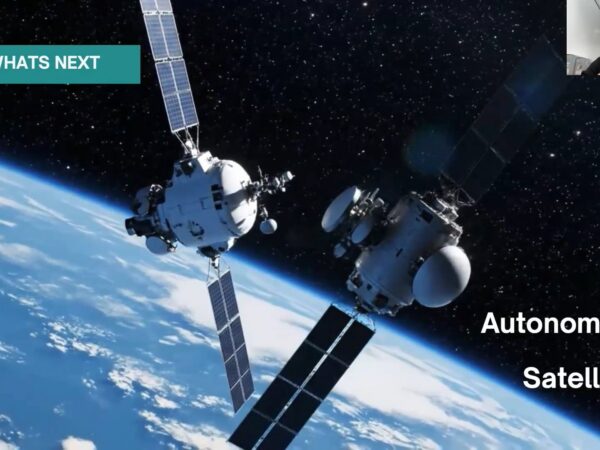
Space Logistics: The “Roadside Service” of Orbit
Learn how Space Machines Company is developing the capability to service spacecraft, manage space junk, and provide roadside assistance to satellites in trouble. Described as the “Roadside Assistance for Space,” the company is building a network of serviceable vehicles to repair, refuel, and manage satellites already in orbit.
[00:00:10] Space Machines Company provides logistics in space. Much like roadside assistance on Earth, they offer servicing for satellites that encounter issues in orbit. This involves building a network of serviceable vehicles that can approach and assist existing spacecraft.
From Intern to Engineer
[00:04:42] The team features young professionals who started as interns. Liv Heaton, an electronics intern, gained critical experience wiring an entire satellite during her second year of university. John McClean, an undergraduate engineer, transitioned from software engineering to space robotics by participating in competitions to build mock lunar and Martian rovers at UTS.
The Challenge of In-Orbit Servicing
[00:01:54] The company recently launched Optimus, a 350kg satellite standing about 1.8 meters tall. Optimus acts as a platform for customer payloads and technology demonstrations. To service a satellite, the team must use advanced vision algorithms to track targets moving at 7.5 kilometers per second.
[00:07:35] Imaging a moving satellite is particularly difficult if the target has lost power and cannot communicate. In these cases, the team relies entirely on visual tracking to plot a trajectory and safely intercept the spacecraft without using excessive fuel.
Cleaning Up the “Graveyard”
[00:08:27] Space junk is a significant and growing problem. Space Machines Company is working on “junk removal” demonstrations to address dead satellites and spent rocket stages. There are two primary methods for dealing with orbital debris:
- Atmospheric Re-entry: For smaller objects, they can be pushed into a lower orbit to burn up in the Earth’s atmosphere.
- The Graveyard Orbit: For large objects that might not burn up completely, they are moved into a “graveyard” orbit far away from active satellites where they can stay safely forever.
The Future of Local Space Industry
[00:23:46] John notes that in the past, Australian citizens often had to move to the US or Europe to work on real spacecraft. Today, the domestic industry is booming. Companies based in Sydney now allow engineers to work on real-world space missions and take high-resolution images of orbit right from their local CBD.
Home » Articles »